

Introduction
In a world dominated by digital screens, continuous pop-up ads, and overflowing email inboxes, print materials remain one of the most powerful and effective communication tools available to modern businesses. From striking business cards handed out at networking events to high-impact brochures, customized packaging, and vibrant large-format banners, tangible marketing materials create a physical connection between your brand and your target audience that digital channels simply cannot match.
Many marketers mistakenly believe that print is a relic of the past. However, research and consumer behavior consistently demonstrate the opposite: print materials command higher attention spans, foster deeper brand trust, and generate impressive response rates when integrated into a modern multi-channel strategy.
Whether you are a small business owner launching a new storefront, an enterprise corporate brand updating your collateral, or a marketer looking to stand out in a saturated marketplace, understanding how to leverage print materials effectively is essential. In this comprehensive guide, we will explore the different types of print materials, their unique business benefits, design best practices, paper selection strategies, prepress production technicalities, advanced finishing techniques, and how to seamlessly integrate physical media with modern digital touchpoints.
Why Print Materials Still Matter in a Digital World
While digital advertising offers immediate reach, it also suffers from digital fatigue. Consumers encounter thousands of digital ads every day, leading to ad-blocker usage, fast scrolling, and screen burnout. High-quality print materials cut through this digital noise by providing a tactile, memorable experience that engages multiple senses.
Key Advantages of Physical Print Media
-
Enhanced Cognitive Recall and Retention: Neuroscientific studies show that physical media requires less cognitive effort to process than digital media and creates stronger neural memory traces. When people touch paper, feel textured finishes, and hold physical print materials, they retain the information longer and build stronger emotional connections with the brand.
-
Higher Credibility and Brand Trust: Anyone can create a temporary landing page or run a social media ad in minutes. However, investing in well-designed, professionally produced print materials signals permanence, legitimacy, and professional dedication. Consumers naturally perceive brands that utilize print as more established and trustworthy.
-
Zero Digital Distractions: When a customer reads a printed brochure, catalog, print materials or flyer, there are no banner ads, push notifications, or open browser tabs competing for their attention. Print offers an uninterrupted reading experience that allows your message to sink in deeply.
-
Longer Lifespan and Shelf Life: An email can be deleted or ignored in a fraction of a second. In contrast, physical print materials like brochures, booklets, and corporate folders often stay on desks, coffee tables, and kitchen counters for days, weeks, or even months, delivering repeated visual exposure to multiple decision-makers.
-
Multisensory Engagement: Physical print appeals to touch, sight, and even smell (the distinct scent of fresh press inks and high-grade paper). Engaging multiple senses creates a richer, more immersive brand experience that digital screens cannot recreate.
Essential Categories of Print Materials for Every Business
To build a cohesive and impactful brand identity, you must choose the right format for your specific communication goals. Print materials span a broad spectrum of formats, each serving a unique function within your sales and marketing funnel.
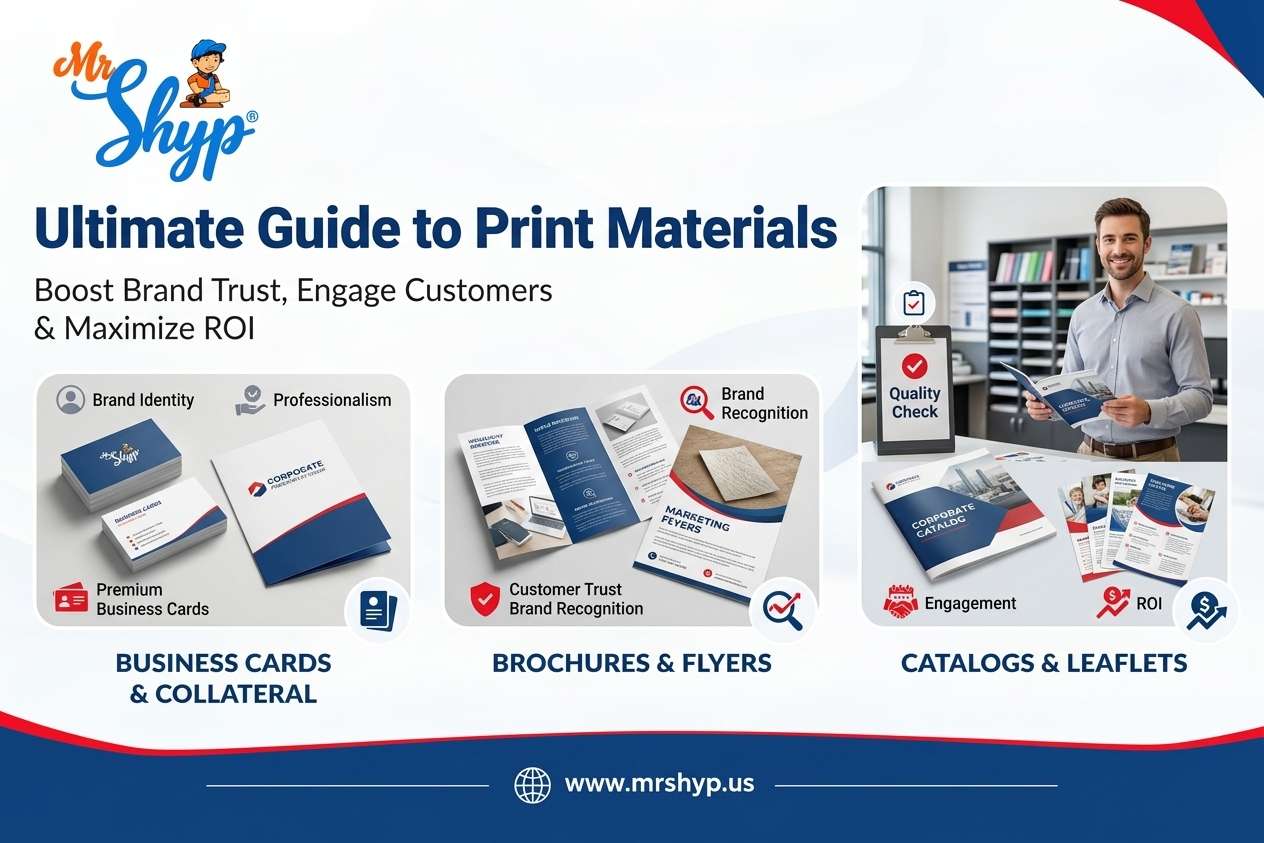
Business Stationery and Corporate Collateral
Your corporate stationery forms the foundation of your brand’s physical presence. It ensures that every contract, letter, and face-to-face interaction reinforces your visual identity.
-
Business Cards: Despite the rise of digital contact sharing, the exchange of premium business cards remains an essential business ritual worldwide. A heavy, well-textured card with custom finishes like foil stamping or spot UV leaves a lasting first impression after a meeting or sales call.
-
Letterheads and Envelopes: Branded corporate stationery elevates everyday business correspondence, invoice delivery, and official documentation, projecting polish and professionalism.
-
Presentation Folders: Custom pocket folders organize press kits, proposals, contracts, and sales sheets into a neat, corporate package for meetings and client onboarding.
-
Notepads and Desk Calendars: Useful office items branded with your company logo keep your organization top-of-mind on your clients’ desks every single business day.
Marketing and Sales Collateral
Marketing collateral is designed to educate, inform, and persuade prospective buyers at various stages of the sales process.
-
Brochures: Available in bi-fold, tri-fold, gate-fold, and multi-page configurations, brochures offer organized space to explain complex services, present product lines, or tell your company story.
-
Flyers and Handouts: Lightweight and economical, flyers are ideal for promotional event distribution, store grand openings, menu highlights, and targeted local marketing campaigns.
-
Catalogs and Magazines: Multi-page printed catalogs remain a cornerstone for retail, wholesale, and fashion brands. They inspire readers, encourage browsing, and drive both online and offline purchasing activity.
-
Sell Sheets and Data Sheets: Single-page informational sheets highlight key product specifications, features, and pricing for sales teams to share during corporate presentations.
-
Case Study Booklets: Printed customer success stories provide tangible social proof during high-stakes B2B sales meetings and contract negotiations.
Direct Mail and Response Print Materials
Direct mail is experiencing a major resurgence as inboxes become overcrowded. Delivering physical messages directly to residential mailboxes yields high open rates and strong ROI.
-
Postcards: Oversized postcards with clear headlines and strong call-to-action messaging deliver concise, high-impact offers directly to homes and offices.
-
Door Hangers: Target specific local neighborhoods with localized offers, home service announcements, or restaurant menu drops.
-
Self-Mailers and Folded Cards: Provide additional space for detailed promotional stories without requiring a separate envelope.
-
Dimensional Mailers: High-value direct mail pieces housed in custom boxes or tubes that command immediate attention upon arrival.
Large-Format Graphics and Event Signage
When you need to capture attention from a distance, large-format print materials ensure your brand commands space at trade shows, storefronts, and outdoor venues.
-
Banners and Flags: Vinyl, mesh, and fabric banners withstand weather conditions while highlighting grand openings, sales events, or sponsorship presence.
-
Trade Show Booth Displays: Retractable roll-up banners, pop-up backdrops, table runners, and graphics create an inviting environment for event attendees.
-
Window Graphics and Wall Decals: Transform glass storefronts and office walls into interactive visual branding spaces.
-
A-Frame Signage and Sidewalk Signs: Catch foot traffic outside retail shops, cafes, and service centers with durable, interchangeable promotional signs. Print materials very important.
Custom Packaging and Product Labels
Product packaging is often the very first physical interaction a buyer has with your brand after purchasing online or off a retail shelf.
-
Custom Boxes and Mailers: Corrugated shipping boxes and custom folding cartons turn unboxing into a shareable experience.
-
Product Labels and Stickers: Durable, water-resistant labels ensure your brand messaging stays clear on bottles, jars, bags, and containers.
-
Hang Tags: Add a touch of craft and quality to apparel, artisanal goods, and retail products.
-
Tissue Paper and Packaging Inserts: Branded wrapping paper, thank-you cards, and coupon inserts elevate the customer unboxing journey and incentivize repeat purchases.
Print Materials vs. Digital Marketing: A Strategic Comparison
Rather than viewing physical print and digital marketing as opposing forces, successful brands treat them as complementary elements of a unified marketing strategy.
Engagement Style
Print materials offer a sensory, tactile, and highly focused experience. In contrast, digital marketing channels are interactive, fast-paced, and browsing-based.
Information Retention
Physical print materials deliver exceptionally high information retention due to strong neural memory traces. Digital media typically results in moderate retention because readers tend to scan through content quickly.
Trust and Credibility Perception
Consumers naturally perceive professionally produced print materials with exceptionally high trust and legitimacy. Digital channels carry variable trust levels due to high ad saturation and digital fatigue.
Lifespan
Printed materials boast a long lifespan, staying on desks, coffee tables, or counters for days to months. Digital ads and emails have a short lifespan, often lasting only a few seconds in a feed or inbox.
Designing High-Impact Print Materials: Best Practices
Creating effective print materials requires a different design mindset than designing for digital screens. Pixels behave differently than ink on paper, and subtle details in layout, color setup, and typography can make or break your final printed product.
Color Modes: RGB vs. CMYK
One of the most common mistakes in print design is submitting artwork prepared in the wrong color space.
-
RGB (Red, Green, Blue): Used strictly for digital screens (monitors, smartphones, TVs) that emit light.
-
CMYK (Cyan, Magenta, Yellow, Key/Black): Used for physical printing presses that apply ink onto paper.
Always convert screen design files from RGB to CMYK before sending them to press. This step prevents unexpected color shifts and ensures that your brand colors render accurately on the physical paper stock.
Pantone Matching System (PMS) for Brand Consistency
For exact color accuracy across different print materials and production runs, rely on the Pantone Matching System (PMS). Unlike CMYK mixing, Pantone inks are pre-mixed spot colors that guarantee your corporate brand colors look identical on a business card, a vinyl banner, and a corrugated box.
Step-by-Step Color and File Setup Workflow
Design in CMYK Mode: Start your document setup in CMYK color mode rather than RGB screen mode.
Set Bleed Lines: Extend your background artwork and graphics 0.125 inches (3mm) beyond the final paper cut boundary.
Verify Image Resolution: Confirm that all embedded images and graphics meet a minimum resolution of 300 DPI at full print size.
Define Spot Colors: Specify Pantone spot colors for logos or precise corporate branding elements.
Check Proofs Carefully: Review digital PDF proofs and physical hard-copy press proofs to spot typographical or alignment errors before full production.
Final Print Production: Authorize final production once all prepress checks, colors, and layout dimensions are fully approved.
Understanding Bleed, Safety Margins, and Trim Lines
To ensure your artwork extends all the way to the edge of the paper without leaving white borders, your files must include appropriate margins:
-
Trim Line: The final edge where the paper will be cut after printing.
-
Bleed Area: The extended background design area (typically 0.125 inches or 3mm beyond the trim line) that accounts for minor movements during cutting.
-
Safety Margin (Safe Zone): The inner area (usually 0.125 inches inside the trim line) where all critical text, logos, and essential graphics must remain to avoid getting clipped.
Resolution Requirements for Crisp Printing
Screen images often render at 72 DPI (dots per inch), which looks fine on digital displays but appears blurry, pixelated, and unprofessional when printed. For crisp, high-quality output, all imagery and graphics within your print materials must be set to a minimum of 300 DPI at full print size.
Typography and Contrast Selection
Reading text on paper is a physical experience. Follow these guidelines for readable print materials:
-
Keep body font sizes readable (typically between 9pt and 12pt for brochures and documents).
-
Use high-contrast color pairings, such as dark navy or black typography against clean white or light neutral backgrounds.
-
Avoid ultra-thin or delicate font weights on dark, textured backgrounds where ink spread (ink bleed) might fill in tiny letter loops.
-
Convert all font files to outlines or vector paths before exporting your final print-ready PDF files to avoid missing font errors at press time.
Choosing the Right Paper Stock and Specialty Finishes
The choice of paper stock transforms a simple graphic into a tactile experience. The weight, texture, coating, and special finishes of your print materials convey subtle quality cues about your brand value before a customer reads a single word.
Paper Finish Categories
-
Uncoated Stock: Delivers a natural, textured feel that is easy to write on. It is ideal for official stationery, letterheads, workbooks, and transactional forms.
-
Gloss Coated Stock: Creates a shiny, reflective surface that enhances vibrant color contrast and image sharpness. It is perfect for heavy photography, promotional flyers, and restaurant menus.
-
Matte / Satin Stock: Provides a smooth, non-glare finish that offers an elegant, modern visual depth. It is preferred for premium corporate brochures, portfolios, and reports.
-
Linen & Textured Stocks: Features woven patterns that impart a classic, high-end feel suitable for luxury certificates, diplomas, and executive stationery.
Paper Weights Explained
Paper weight measures thickness and density. Choosing the correct weight ensures your print materials feel sturdy and appropriate for their intended use:
-
20lb to 28lb Bond (75 – 105 GSM): Standard lightweight paper typically used for everyday office printing, letterheads, and multi-page transactional forms.
-
80lb to 100lb Text (120 – 150 GSM): Versatile, medium-weight paper stock standard for brochure pages, flyer handouts, catalog interiors, and corporate newsletters.
-
80lb to 130lb Cover / Cardstock (220 – 350 GSM): Thick, heavy paper stock used for business cards, postcard mailers, presentation folder covers, and product packaging.
-
Extra-Thick Triple-Layer Cardstock (400+ GSM): Ultra-heavy stock featuring colored middle layers, perfect for luxury business cards that do not bend.
Coatings and Special Finishes
Enhance the appearance and durability of your physical pieces with special coatings and tactile print finishes:
-
Gloss Coating: Creates a shiny, reflective surface that enhances color contrast and image sharpness, making photographs pop.
-
Matte / Satin Coating: Offers a smooth, non-glare finish that delivers an elegant, modern feel with soft visual depth.
-
Soft-Touch Lamination: Adds a velvety, suede-like texture that feels luxurious to the touch while protecting the paper against fingerprints and wear.
-
Spot UV Coating: Applies a high-gloss, raised clear coat to targeted visual areas (like logos, headlines, or geometric patterns) to create a striking contrast against a matte background.
-
Foil Stamping: Presses metallic foil (gold, silver, copper, or holographic) onto paper for a luxury appearance on corporate stationery, awards, and premium packaging.
-
Embossing and Debossing: Creates raised (embossed) or recessed (debossed) 3D patterns on the paper surface for an understated tactile impression.
-
Die-Cutting: Uses specialized steel blades to cut custom shapes, windows, or rounded corners out of paper stock to create unique marketing shapes.
How to Integrate Print Materials with Digital Campaigns (Phygital Marketing)
Modern marketing strategies do not treat print and digital as separate siloes. Instead, high-performing brands connect physical print materials to digital experiences, creating a seamless multi-touch journey known as “phygital” marketing.
Phygital Campaign Integration Journey
Printed Material: Distribute a high-impact physical touchpoint, such as a postcard, brochure, or flyer.
Interactive Bridge: Include an easy digital gateway like a dynamic QR code or custom PURL.
Digital Destination: Direct the recipient to a personalized, mobile-optimized landing page or video presentation.
Analytics & Tracking: Monitor scan rates, traffic conversion, and individual customer engagement metrics in real time.
Final Conversion: Guide the prospect to complete a purchase, book a call, or submit an inquiry form.
Strategies for Digital-Print Synergy
-
Incorporate Dynamic QR Codes: Place dynamic QR codes on brochures, business cards, or banners to allow users to scan and instantly watch a product demo, view a 3D model, or save contact details
-
Add NFC Technology: Embed Near Field Communication chips into luxury cards or signage to trigger instant digital downloads or augmented reality experiences when tapped with a smartphone.
-
Augmented Reality (AR) Triggers: Print scannable image triggers on catalogs or packaging that launch interactive 3D product visualizers or video overlays directly through a phone camera.
-
Drive Social Media Engagement: Feature branded hashtags and photo contest details on product packaging to turn physical unboxing moments into user-generated content online.
Environmental Sustainability in Modern Print Production
As consumer awareness around sustainability grows, modern print manufacturing has evolved to prioritize eco-friendly practices. Implementing sustainable print practices allows your organization to reduce its environmental footprint while appealing to eco-conscious buyers.
Eco-Friendly Print Strategies
-
FSC-Certified Paper: The Forest Stewardship Council (FSC) certification ensures that paper stock comes from responsibly managed forests that provide environmental, social, and economic benefits.
-
Recycled Post-Consumer Waste (PCW) Papers: Utilizing paper made from post-consumer recycled fibers reduces landfill waste and conserves energy and water during manufacturing.
-
Soy and Vegetable-Based Inks: Traditional petroleum-based inks release volatile organic compounds (VOCs) during drying. Soy and vegetable-based alternatives produce vibrant colors, lower VOC emissions, and make paper de-inking easier during recycling.
-
Waterless Printing Technology: Eliminates the use of water-based damping systems during offset production, saving thousands of gallons of water and reducing chemical waste.
-
On-Demand Digital Printing: Printing materials in small, precise quantities using digital press technology eliminates overproduction and prevents obsolete inventory from ending up in recycling bins.
Common Issues in Print Production and How to Avoid Them
Even seasoned marketers run into unexpected results if print files are prepared incorrectly. Below is a practical guide to troubleshooting common print production pitfalls before sending files to the press:
-
Blurry or Pixelated Images: Caused by using low-resolution Web images (72 DPI). Always supply graphics at 300 DPI at full print size.
-
Unexpected Color Shifts: Caused by designing in RGB mode and converting to CMYK late in the process. Design in CMYK from the start to preview actual ink representations.
-
Unintended White Borders: Caused by omitting bleed margins. Extend background images and solid colors at least 0.125 inches past the trim line.
-
Text Trim Clipping: Caused by placing important typography too close to the paper edge. Maintain a 0.125-inch safe zone inside the trim line.
-
Dark, Muddy Blacks: Caused by using 100% K (single-channel black) for large solid background areas. Use a “Rich Black” formula (e.g., C=60%, M=40%, Y=40%, K=100%) for deep, solid black coverage on heavy stock.
-
Paper Cracking on Folds: Occurs when folding heavy cardstock without first scoring the paper. Always request professional scoring on items over 100lb cover weight before folding.
Frequently Asked Questions About Print Materials
What is the difference between digital printing and offset printing?
Digital printing transfers digital files directly onto paper, print materials using toner or liquid ink, making it cost-effective for short print runs, fast turnarounds, and variable data personalization. Offset printing uses aluminum plates to transfer ink onto rubber blankets before pressing onto paper. Offset printing requires higher setup costs but offers superior color accuracy, lower unit costs on high-volume runs, and compatibility with specialized paper stocks and finishes.
How do I choose between gloss, matte, and uncoated paper finishes?
Choose gloss finish if your print materials feature heavy photography, vibrant colors, or visual product imagery (such as restaurant menus or promotional flyers). Choose matte finish for professional corporate brochures, corporate portfolios, and items where non-glare readability and modern elegance matter. Choose uncoated stock for stationery, letterheads, workbooks, and forms that require writing with a pen or pencil.
What is GSM, and how does it relate to paper weight?
GSM stands for “Grams per Square Meter” and measures the actual metric density of paper. A higher GSM number indicates a thicker, heavier sheet of paper. For example, standard printer paper is around 80 GSM, a quality brochure page is around 150 GSM, and a sturdy business card ranges from 300 GSM to 350+ GSM.
How far in advance should I plan print production for major events?
Plan print material production at least 2 to 3 weeks before major trade shows, product launches, or marketing campaigns. This window allows ample time for file proofing, digital proofs, physical press adjustments, custom finishing application (such as foil stamping or embossing), and shipping delivery without incurring rush fees.
What is variable data printing (VDP)?
Variable data printing is a form of digital printing that allows text, graphics, and images to change from one printed piece to the next without stopping or slowing down the press. It is widely used in direct mail campaigns to address recipients by name, offer custom localized discounts, or show tailored product recommendations based on customer data.
Conclusion
Despite the continuous expansion of digital communication channels, physical print materials remain an essential component of a successful, well-rounded marketing strategy. Print provides a tangible experience that builds brand credibility, captures undivided consumer attention, and delivers lasting visual exposure that digital ads simply cannot replicate.
By combining thoughtful graphic design, correct prepress file preparation, premium paper stock selections, and strategic digital integration (such as dynamic QR codes and personal URLs), your business can craft high-impact print materials that stand out, drive conversions, and deliver a high return on investment.
Take time to review your current physical collateral. Align your printed assets with your modern brand identity, invest in quality production, and give your target audience a physical connection to your brand that they can hold in their hands.